
Dropshipping in 2026: what actually moves the needle
No course, no guru talk. What matters when building a dropshipping business today: product, economics, your page, creatives and how to scale.

The same questions keep coming up: what product should I sell, what interests should I target, how much should I spend on Meta, why do I get clicks but no sales? This is what we have learned, partly by making the mistakes ourselves. No course, no "make $10K while sleeping". Just what matters.
Dropshipping is not passive income
The model is simple: the customer buys, you source, the supplier ships, you keep the margin. But that margin has to pay for the product, shipping, payment fees, advertising, refunds and your profit. That is a real business. And 2026 is very different from 2020: a generic store with random products and basic ads won't cut it. The advantage now comes from understanding the customer and showing value faster than anyone else.
Product first
Great ads, a great website and great targeting still lose with a weak product. For paid social, look for products that make someone think "wait, I need that": they solve a frustrating problem, create strong desire or have an obvious "wow". If it takes five minutes to explain why someone needs it, that's a red flag.
Check the economics before running ads. As a rule of thumb, aim for a selling price of roughly 3× the sourcing cost or more, then work out your break-even cost per acquisition. If you make $20 before advertising, paying $25 to win a customer isn't a business, it's a donation.
And order a sample. Supplier photos are not reality.
How to research products
The free Meta Ad Library is great, but search problems, not product names. Look for ads that have been running for a while, then read the comments. They tell you what customers love, hate, don't understand and object to, and which features they really care about. That's free customer research most people scroll past.
Your page has one job
Someone coming from an ad gives you seconds to earn trust, not minutes. Your product page should answer: what is this, why do I need it, why should I trust you, why should I buy now? Sell the outcome in the headline, make reviews feel real and keep trust signals visible. Delete the 27 apps you installed because a YouTuber said so: each one adds friction. Fast, simple and trustworthy beats complicated and "professional".
Meta ads: keep it boring
A simple testing setup: one campaign, purchase objective, broad targeting, few restrictions. Let the creative do the work, and don't mix up audience tests with creative tests. Show the same broad audience a problem-focused ad, a lifestyle ad and a demo: same people, different reasons to care.
Creative is the real targeting. Polished doesn't mean better. Some of the best ads look like a phone video of a real person talking, slightly imperfect: "something my friend would send me". The first two seconds matter enormously, so test several hooks for the same product and change only the opening. One sentence can change the economics.
Don't obsess over CTR
A high CTR only says people clicked. Diagnose like a funnel, in this order: CTR, add-to-cart, purchase, CPA, ROAS.
- Low CTR? Fix the creative.
- Good CTR but no add-to-carts? Look at the product page and the offer.
- Add-to-carts but no purchases? Check checkout, trust, pricing and friction.
- Purchases but bad economics? Fix the unit economics or the acquisition cost.
Don't change everything at once.
When to kill an ad, and how to scale
Don't panic after one bad day, and don't fall in love with one good day. My rule: if I've spent about the product's selling price and see no meaningful purchase intent, I move on. But if people are adding to cart, that's information. Maybe the ad works and the website leaks. Diagnose before you destroy.
When you find a winner, don't jump from $30 to $300 a day. Raise the budget gradually (+20–30%), let it stabilize, then raise it again. The goal isn't to spend more, it's to spend more profitably.
The biggest lesson
The most expensive habit in dropshipping is making permanent decisions from temporary data. One bad day: "the product is dead." One good day: "I'm rich." Look at the trend, week after week.
So don't ask "how do I find a winning product?" Ask "how do I build a system that can repeatedly find, test and scale opportunities?" That's a bigger game, and a more sustainable one.
If you are building your first brand, tell us where you're stuck: product, creative, ads, website, conversion or scaling?
Keep reading
 Ecommerce & dropshipping
I spent $3K on Meta and people still aren't buying
A solo founder's story: great CTR, add-to-carts and zero purchases. Three suspects for where the funnel breaks, and what to test next.
Read article Ecommerce & dropshipping
When dropshipping turns into a supply chain operation
Repeat demand, more SKUs and quality complaints mean you need more than a product feed. The signals, the stages and what to control first.
Read article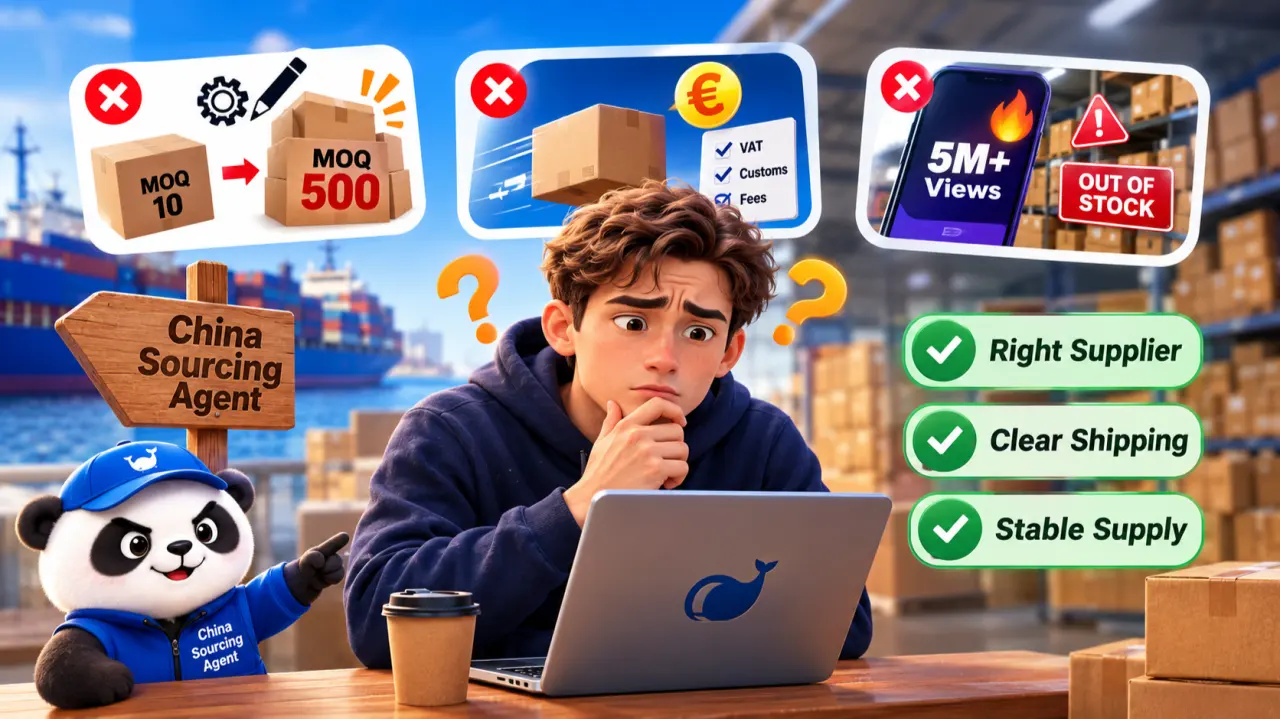 Ecommerce & dropshipping
3 mistakes new dropshippers keep making, from a sourcing agent in China
MOQ that jumps when you customize, the cheapest shipping that costs the most, and a viral product with a supplier that can't scale.
Read article