
I spent $3K on Meta and people still aren't buying
A solo founder's story: great CTR, add-to-carts and zero purchases. Three suspects for where the funnel breaks, and what to test next.

A founder's story from the community, shared because it's a lesson many first-time sellers learn the hard way.
I'm a solo founder building my first brand. Product, website, ads, creatives: all me, plus a few questionable decisions at 2am. The product is a caffeine-free nootropic for focus and mental clarity, and I've spent around $3K on Meta so far.
Here's what drives me crazy: the ads are working. One creative gets about 10% CTR at roughly $5.69 per add-to-cart. Another "burnout" hook gets about 16% CTR.
And yet: 880 Shopify sessions in about 14 days, around 20 people reached checkout, and zero purchases. My last real sale was three weeks ago.
The product
Nine active ingredients, every dose shown on the label, developed with a neurologist. Pricing: $49 for one bottle, $79.90 for two, $109.90 for three. Buying the ingredients separately costs roughly $115–142 a month, and competitors like Mind Lab Pro and Alpha Brain sit at much higher prices. Decent product, decent price. So I ran ads.
What I learned about Meta
My polished benefits creative got a 0.35% CTR: dead. My raw, native "burnout" creative got about 16%. The lesson: stop making ads that look like ads.
But then the next problem. People clicked, added to cart, some even started checkout, and then nothing. CTR can be a dopamine trap. It feels amazing until you check revenue.
Three suspects
1. Checkout. The boring one, maybe the most important. The pixel fires and test orders work, and one real customer paid with Apple Pay. But I haven't fully tested manual card and guest checkout. A wrong field, a payment issue, mobile UX or a shipping surprise could be killing conversions, and if so, another $3K of "optimizing Meta" would achieve nothing.
2. The offer. The ads make people curious, then they reach the product page and wonder why they should trust it. With something you put in your body, "9 ingredients", "formulated with a neurologist" and "cheaper than buying separately" aren't enough. People want to know: will it help me, why this one, why this brand, and what if it doesn't work?
3. The traffic. Meta is great at finding people who click, which doesn't mean they'll buy. But before blaming the algorithm I want to prove the buying experience works.
My next experiment
I'm going back to optimizing for Add to Cart and sending traffic straight to the product page. I'm also testing something I should have done earlier: me. No polished commercial, just me talking to the camera about why I built it, what problem I had, why it's caffeine-free and what I believe it can do. And I'm building an advertorial page, because this product needs the problem understood before the solution. Instead of Ad → Product → Buy, I'm testing Ad → Story → Product → Buy.
Where would you put the next $200?
- A. Fixing and testing checkout
- B. Reworking the offer and product page
- C. Testing founder-led creatives
- D. Testing an advertorial funnel
- E. Going after the traffic itself
I'm done throwing money at random variables. I want to find the one broken link. After about $3K, here's what I wish I'd known earlier: getting attention is not the same as getting trust, and getting trust is not the same as getting the sale. I can get the attention. Now I need to find where I'm losing the trust.
Keep reading
 Ecommerce & dropshipping
Dropshipping in 2026: what actually moves the needle
No course, no guru talk. What matters when building a dropshipping business today: product, economics, your page, creatives and how to scale.
Read article Ecommerce & dropshipping
When dropshipping turns into a supply chain operation
Repeat demand, more SKUs and quality complaints mean you need more than a product feed. The signals, the stages and what to control first.
Read article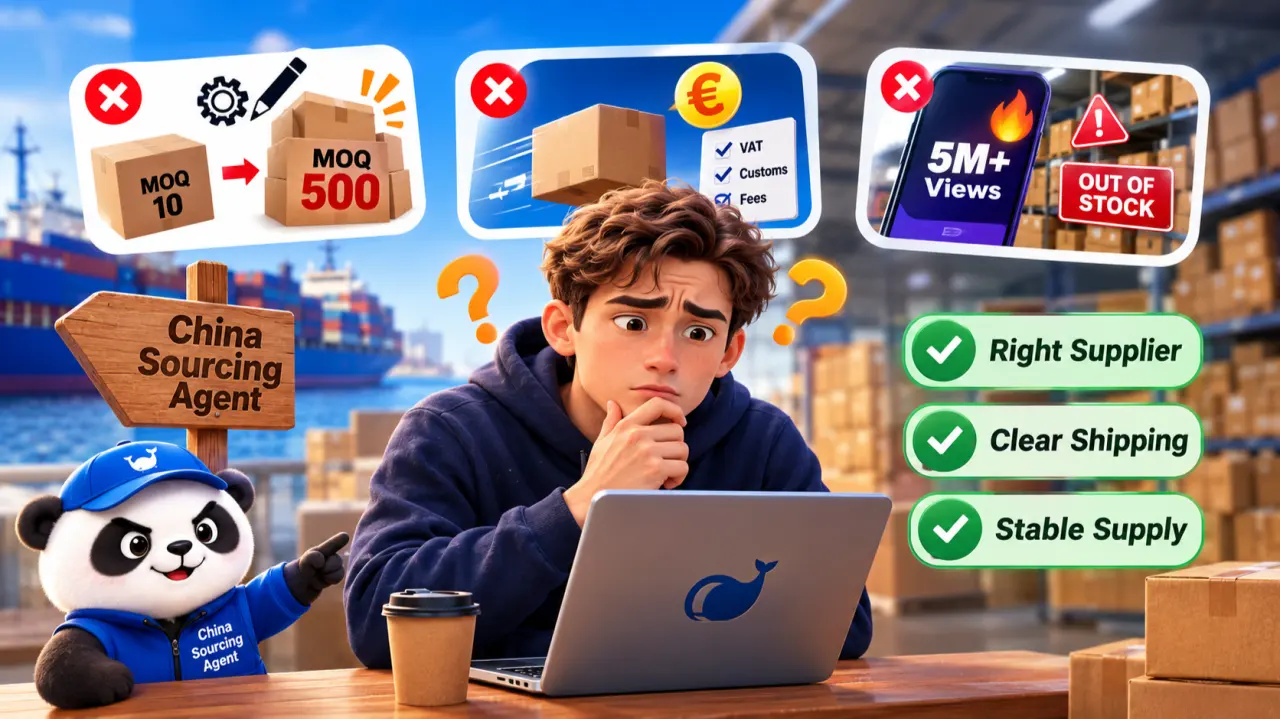 Ecommerce & dropshipping
3 mistakes new dropshippers keep making, from a sourcing agent in China
MOQ that jumps when you customize, the cheapest shipping that costs the most, and a viral product with a supplier that can't scale.
Read article